Japan is Cheap (With Conditions)

A conclusion reached yesterday, after five weeks in the country: Japan is indeed cheap. But let me qualify that. Right now, it is cheap; and, it feels cheap in relative terms if you work abroad.
Yesterday. I had my usual eggs for breakfast, paired with a beautiful piece of salmon that was priced around $10/kg. In Australia, the cost of fresh seafood like this often exceeds $40-50/kg.
We checked out of our $15/night apartment in Ōsaka Bay. It was wonderful. We tried extending our stay, but there were already tenants booked. Fortunately, we were able to book a different central Ōsaka apartment for $20/night each with one day’s notice. I’ll come back to it. It’s arguably even nicer.
Hop on two trains. The transit time given to us by Google Maps was exact to what felt like the millisecond. I feel a little sheepish knowing my privilege now that public transit in Brisbane is now 50 cents. Every other price feels unfair now. But ¥290 is a reasonable price for world-class transport. Certainly one I’ve been willing to pay, over and over again.
We walk to a park. Find a vending machine on the way. Or, more specifically—we see many vending machines on our route; it just so happens that we stumble into one selling coffee for ¥60. Many different types. From a hot fridge. I’d pay the 60 cents for hand warmers alone. Add in a 1pm caffeine hit and it becomes a no-brainer.
Our check-in isn’t until 4pm, so we walk a little further. Past several FamilyMarts and towards a supermarket. When you first arrive in Japan, the konbini immediately grab your attention. Rightfully so. The convenience they provide comes at great value. That being said—the FamilyMart onigiri many foreigners associate with affordable ease? You can buy it at half that price at the supermarket down the road. So, I do.
We vow to return after checking in. Upon our 4pm arrival, our home for the next week greets us strongly. It only had one review when we booked. I now know why. It is literally brand new. As though the single reviewer was the only previous tenant. The place is decorated in a homely fashion. Real discernment, artistic choice, and care went into the design here. It beautifully contrasts the expected monotony of hotels rooms, underscored by pale yellow walls. The type you might cringe at briefly, then realise later you’ve come to love.
It has literally everything you could want, all functioning as efficiently as possible. Massive fridge and freezer. Brand new induction cooktop and fully functioning kitchen space. Warm lamps in all the right spots. Heated toilet seat. A barstool desk at just the perfect height. A glass coffee table featuring flowers and art that complements the room. A couch that openly embraces you. One that you can sink into, but not too much. A bath that has a control panel allowing you to set water height, temperature, and automatic filling on a timer. Crucially—well insulated heating!
I know it isn’t the deal of the century, but it is places like this that make living abroad very justifiable. The rent is half what I’d pay to stay at UniCentral. Not even for a long-term rental either.
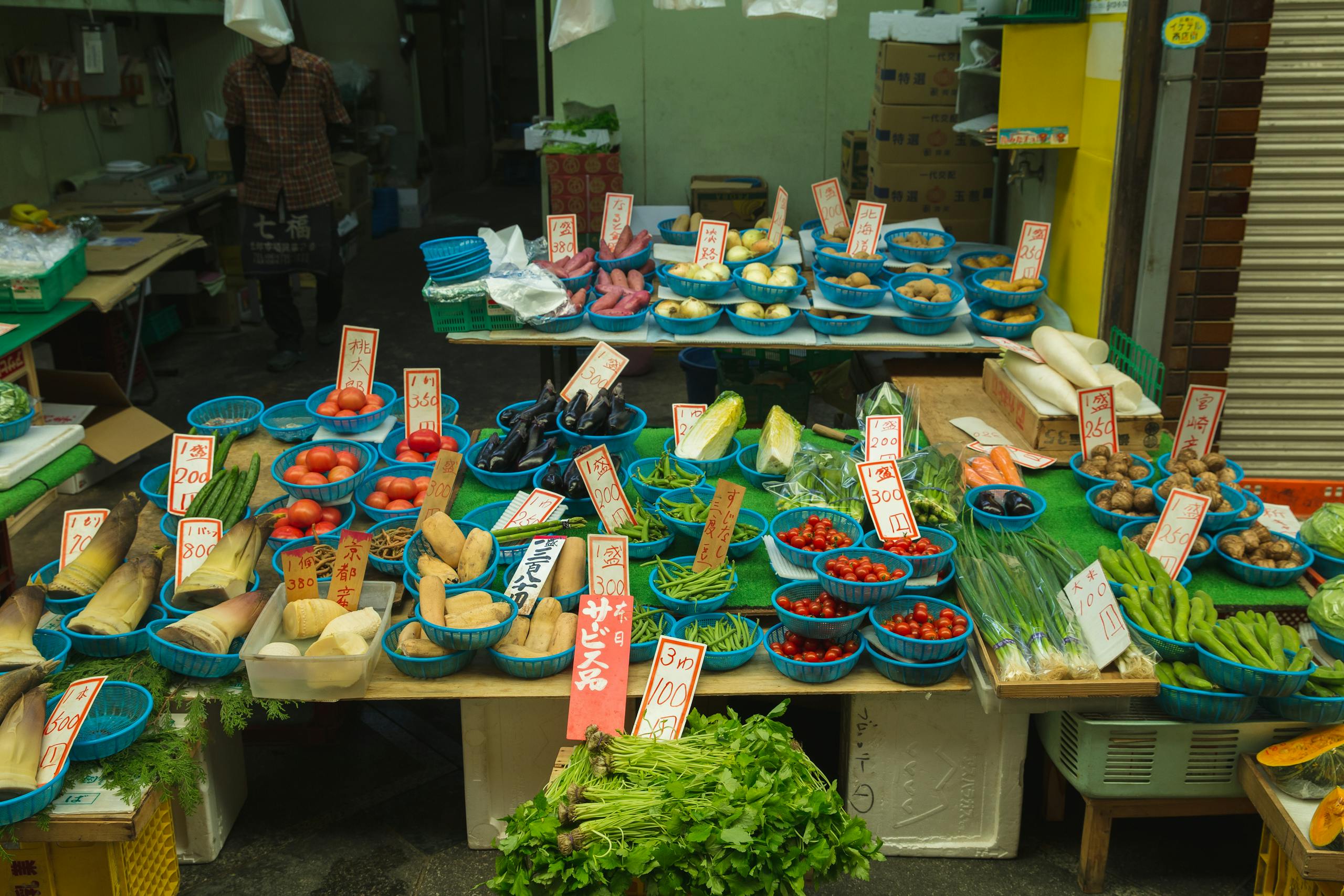
Anyway, back to the shops. If you know where to look, $50 buys two people food for not a week, because I eat quite a lot, but definitely three days. Focusing on fresh produce, too. The fruit and vegetables here can feel more difficult to acquire here than back home. Grapes and strawberries cost a fortune. Many vegetable prices persuade you to look elsewhere. Embracing seasonality is your best friend here. The produce that is cheap is really cheap. I think it is extra important to prioritise as well because you actually don’t find many vegetables in most foods you might lean towards here. You’ll get plenty of white rice though. Although, the temptation is always there to eat out and you should. It usually ends up costing about a third of what you’d pay in Australia to have a meal at a restaurant. Sometimes a whole lot less if you’re ordering something like sashimi.
So, for us Australians, whilst it might always seem like it if staying in a Tokyo hotel or at a Hokkaido ski resort, Japan is a relative bargain. The quality of life here and the social security are also immense. But if you lived and worked here, you probably wouldn’t say the same.
First, the devalued yen makes Japan feel like a country on sale to foreign visitors. Among a broader trend, recent times have marked several historical lows for the yen against foreign currencies, including the Australian dollar. Yet, if you earn in yen, those savings mean nothing to you. Well actually, they make any overseas travel harder for you, and will drive up prices for key commodities, especially considering the Japanese reliance on imports for some goods.
Additionally, working here does not pay as well as you might expect. Despite the strong infrastructure, stable employment culture, and high service standards, wages in Japan are not flash. Although each prefecture individually sets the minimum wage, the collective perspective is that the minimum wage here is not a liveable salary. Additionally, wage growth has been extremely slow here compared to many countries where tourists may visit from. Given recent inflation spikes, a devalued currency, and a tourism influx driving prices higher in some areas, the equation doesn’t quite stack up for locals as you might imagine.
Thus, for myself, Japan is truly cheap. For that, I feel grateful. At the same time, I think perspective is important to maintain. The country offers many great prospects to its citizens, but they’re not looking at the same konbini prices as you with amazement. Perhaps a sigh instead.